Gold Session Liquidity Pro Review: Can This MT5 Tool Help You Trade Smarter?
Gold can move hundreds of points before a trader has even finished calculating position size. The real challenge is not simply finding the next XAUUSD breakout: it is deciding whether the opportunity is worth the risk once spreads, stops and trading costs are included.
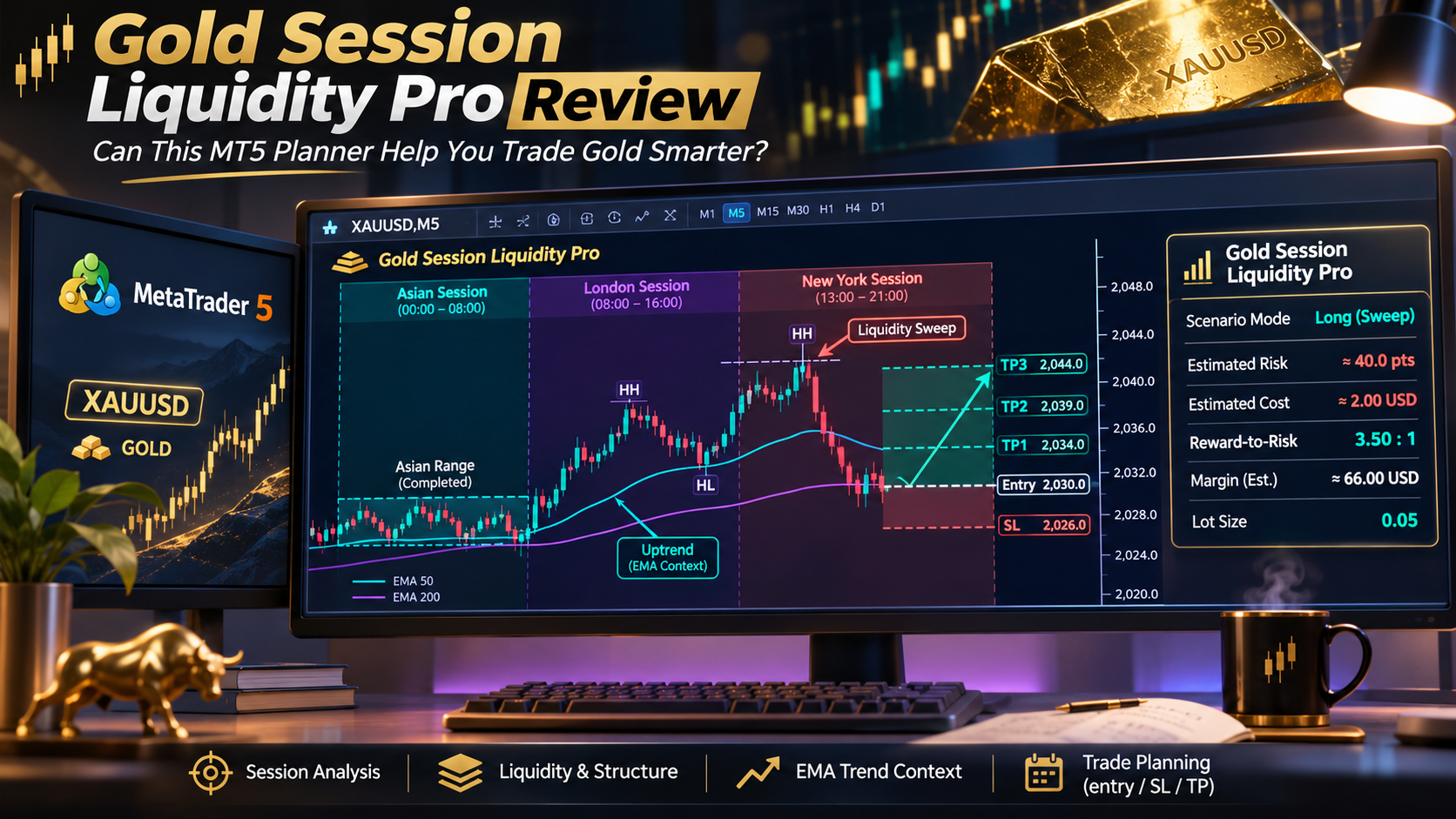
Gold Session Liquidity Pro offers an interesting approach: instead of reducing a complex market to a flashing buy or sell arrow, it puts context and trade preparation together on the MetaTrader 5 chart. This product overview examines where the tool may add value to an XAUUSD strategy, what traders must configure and what it cannot do. It is based on the developer's published specifications and documented demo evaluation, not an independent profitability test. This publication is associated with the indicator developer.
Why gold traders need more than another entry signal
XAUUSD is sensitive to changes in the US dollar, interest-rate expectations, economic releases and shifts in risk appetite. A move above a previous high can become a sustained breakout or a rapid rejection. Even a correct directional view can produce a losing trade if the position is too large, the spread widens or the stop is poorly located.
That is why a tool combining context with risk preparation deserves attention. Rather than asking only whether the next candle will rise, a trader can ask which session is active, where recent reference levels sit, how much a stop would cost and whether the potential payoff remains attractive after expenses.
What Gold Session Liquidity Pro actually does
The official MQL5 Market listing identifies the product as a discretionary planning indicator for MT5, with version 1.40 listed on November 24, 2026. Its chart annotations help organize session and price context; the calculation panel helps evaluate hypothetical orders. It does not submit or manage orders, and its experimental entry signals are disabled in this version.
The dashboard has compact and detailed display modes. Traders can change the planning direction, hold an entry and stop for analysis, or move planning lines to examine alternative scenarios. This is especially helpful when comparing a possible pullback entry with a less favorable market entry.
Finding meaningful reference levels across sessions
Gold does not behave identically at every hour. The Asian session can provide a useful early reference range, while London and New York may introduce different volatility conditions. Session labels help traders separate these periods instead of treating every intraday move as equivalent.
For example, imagine XAUUSD moving below the completed Asian range during London, then reclaiming that reference. A trader might investigate whether subsequent closed candles support a reversal. Alternatively, continued acceptance below the range could invalidate the reversal idea. The indicator helps organize observations, but neither a sweep nor a break predicts the next move.
Its liquidity context is inferred from price action, not institutional order-book data. Configure the broker server clock correctly and remember that analytical session windows are not the same as the broker's actual gold trading hours.
Trend, structure and the difference between analysis and a signal
Higher-timeframe context is useful for filtering noisy intraday observations. The published default uses closed H1 candles with EMA periods 20 and 50; the effective trend period can increase on a longer chart. A bullish background may help a discretionary trader focus on one class of scenario, but it does not guarantee a successful long trade.
Recent structural references and price-based sweep observations offer a framework for asking whether price has broken, rejected or reclaimed a level. The trader must still define a confirmation rule, invalidation point and conditions under which no trade is preferable.
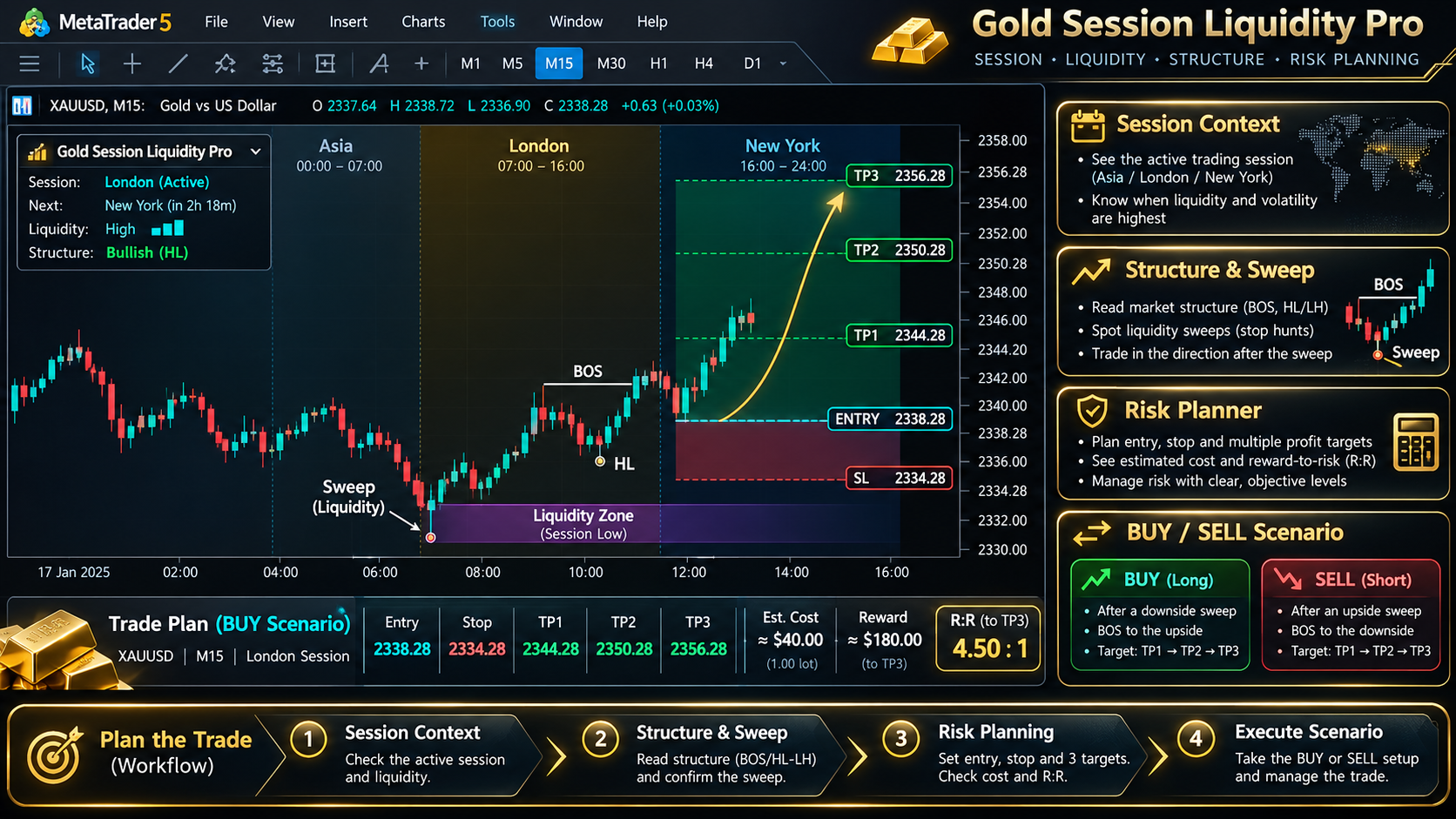
How the risk planner can improve trading decisions
One of the more practical reasons to explore this indicator is its focus on the economics of a position. When the available data permit a calculation, the planner brings the proposed entry, stop, targets, volume, estimated costs and margin into the same workspace. The default risk budget is 0.5% of equity; the three default target distances are 1R, 1.5R and 2.5R before costs. These are configurable assumptions, not optimal settings for every trader.
Consider a hypothetical USD 5,000 account with a 0.5% risk budget. The intended budget is USD 25. If a proposed gold position would lose more than this at its stop after estimated costs, the trader needs a smaller volume or a different plan. A minimum lot-size constraint may make the scenario unsuitable entirely. A wider stop does not automatically mean higher risk if volume is adjusted, while a smaller stop does not automatically mean a safer strategy.
Net reward-to-risk is particularly useful because commission, spread and slippage can reduce the attractive ratios seen on a clean chart. The actual outcome may still differ from estimates because of gaps, execution, swap and broker-specific terms.
A repeatable XAUUSD workflow on MetaTrader 5
- Start with the desktop MT5 platform and the broker's actual gold symbol, ideally on a demo account using M15 for initial evaluation.
- Check symbol specifications, server time, contract size, tick properties, commission and the minimum trade volume.
- Observe the completed session range and higher-timeframe direction. Choose a setup rule before examining the planner.
- Review the hypothetical long or short scenario. Check the stop, cost assumptions, estimated loss, available margin and net target ratios.
- Reject setups that violate your own rules. If the dashboard withholds a plan, investigate the reason rather than forcing an order.
- Record the decision and compare the estimated values with the broker's order preview and, on demo, the actual execution.
The AUTO mode selects a planning direction from trend context; BUY and SELL let you study alternatives. They are scenario selectors, not commands to enter the market. Using fixed entry and stop assumptions can help a trader examine the same idea while cost conditions change.
Can the indicator help you become more profitable?
Possibly, but only if the strategy it supports has a genuine edge. Better sizing, fewer impulsive entries and more realistic cost assumptions can improve the consistency of a process. They cannot turn a negative-expectancy strategy into a positive one by themselves.
Evaluate the tool scientifically: define the same entry and exit rules before testing, record losing as well as winning scenarios and compare results before and after costs. Track expectancy in units of initial risk, maximum drawdown, average loss, average gain and the frequency of rejected setups. Use enough observations across quiet, trending and high-volatility conditions. A visually appealing dashboard is not evidence of profitability.
Compatibility, strengths and limitations
The documented primary evaluation used MT5 desktop, XAUUSD M15 and a USD demo account. The release notes also describe numerical comparison checks on selected symbols, not universal broker certification. Gold contract definitions, minimum volumes and account currencies vary; some unsupported combinations are deliberately blocked. An MT4 edition is not included with this product.
In our view, its main strengths are the organized chart context, manual scenario controls and emphasis on planning risk before execution. Its limitations are the need to configure broker assumptions, the lack of actual order-book visibility and the absence of independently verified profit performance. It is best regarded as a decision-support tool for discretionary traders rather than an automated trading strategy.
Where to explore the indicator
For the actual interface, setup instructions and explanations of the dashboard, read the Gold Session Liquidity Pro MT5 user guide on ForexReview.top. The guide covers an earlier public release; consult the Market listing for version-specific changes and the latest availability.
Explore Gold Session Liquidity Pro on MQL5 Market → The listing is currently subject to a seller restriction as checked on November 24, 2026; review its status before attempting to obtain the product.
Bottom line: If you trade gold manually and want a more structured way to connect session context, price behavior and position economics, Gold Session Liquidity Pro is worth evaluating. Start with a demo, verify the broker-specific numbers and judge it by the quality of your decisions rather than the appearance of its chart.
Risk notice: Leveraged forex and CFD trading involves significant risk. This article is educational and promotional; examples are hypothetical, not investment advice, a performance claim or a guarantee of profit.


No comments